



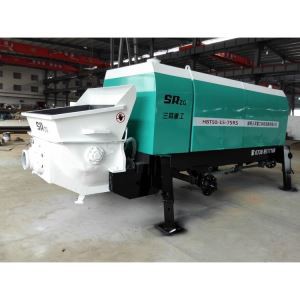
Trail Portable Concrete Pump Crete
Here are some key features and aspects of portable concrete pumps:
Mobility: Portable concrete pumps are designed for easy transportation around a construction site. They may be mounted on trailers, skids, or wheeled frames, making them mobile and adaptable to various job site conditions.
Concrete Pumping Mechanism: These pumps are equipped with a hydraulic system and a pumping unit. The hydraulic system provides the power needed to operate the pump, while the pumping unit draws concrete from a mixer truck or other source and pumps it through pipes, hoses, or boom arms to the desired location.
Pumping Capacity: Portable concrete pumps come in a range of capacities to suit different project requirements. The capacity typically varies from small units capable of pumping a few cubic yards per hour to larger models that can handle higher volumes.
Precision and Control: Portable concrete pumps offer precise control over the placement of concrete, allowing operators to adjust the flow rate and direction of the concrete. This precision is crucial for achieving the desired finish and avoiding over-pouring or spillage.
Versatility: These pumps can handle various concrete mixes and aggregate sizes, making them suitable for a wide range of construction applications.
Reduced Labor: By using a portable concrete pump, the need for manual labor to transport and distribute concrete is minimized. This can lead to increased efficiency and reduced labor costs.
Maintenance: Regular maintenance is essential to keep the portable concrete pump in good working condition. Maintenance tasks typically include lubrication, cleaning, and routine inspections of hydraulic components.
Safety Features: Safety features are integrated into portable concrete pumps to protect operators and the construction site. These features may include emergency stop buttons, safety interlocks, and warning systems.
Accessories: Portable concrete pumps may come with additional accessories such as remote control units, extension hoses, and nozzle attachments to enhance their versatility and usability.
Power Source: These pumps can be powered by various sources, including electric motors, diesel engines, or hybrid systems, depending on the model and manufacturer.
| MODEL: HBT50-13-55S | ||||||
| Max theoretic output | 50m³/h | |||||
| Max concrete pumping pressure | 13Mpa | |||||
| High and low valtage switchover | Yes | |||||
| Hydraulic system | Double pump & double circuit opening | |||||
| Main oil pump discharge | 260ml/r(kawasaki) | |||||
| Hydraulic system pressure | 32Mpa | |||||
| Power supply | Electric motor | |||||
| Voltage | 380V | |||||
| Motor power | 55KW | |||||
| Motor speed | 1475r/min | |||||
| Distribution valve type | S pipe valve | |||||
| Concrete conveying cylinder bore/stroke | Ф200/1650mm | |||||
| Oil cylinder bore/stroke | Ф125/1650mm | |||||
| Max aggregate size | 40mm | |||||
| Hopper Volume | 0.6m³ | |||||
| Feeding height | 1450mm | |||||
| Max delivery vertical distance | 120m | |||||
| Max delivery horizontal distance | 360m | |||||
| Concrete slump | 160-230mm | |||||
| Hydraulic oil tank volume | 420L | |||||
| The radiator cooling type | Air cooling system | |||||
| Hydraulic pump type | Ram pump | |||||
| Outer dimensions(L*W*H) | 5000×2000×2500mm | |||||
| Total weight | 4500 kg | |||||


Here's a detailed overview of their features, benefits, operation, and applications:
Features
Compact Design: Mounted on a trailer for easy transportation and maneuverability, making it suitable for sites with limited access.
Pump Mechanism: Typically utilizes a piston or peristaltic pump mechanism for consistent and reliable concrete flow.
Power Options: Available in both diesel and electric models to cater to different site requirements and environmental conditions.
Hopper with Agitator: Includes a hopper for receiving concrete from mixer trucks, with an agitator to keep the mix well-blended and prevent segregation.
Advanced Control Systems: Equipped with user-friendly control systems, often featuring remote operation for enhanced precision and convenience.
Versatile Delivery System: Capable of pumping concrete over moderate distances and heights, suitable for a variety of project sizes.
Benefits
Mobility: Easily towed to various job sites, ideal for projects requiring frequent relocation or in areas with difficult access.
Versatility: Can handle a wide range of concrete mixes, including standard, lightweight, and specialty formulations.
Efficiency: Facilitates quick and accurate placement of concrete, reducing labor costs and project timelines.
Cost-Effective: Lower initial investment and maintenance costs compared to larger, stationary pumps, making them economical for smaller contractors.
Reduced Footprint: Compact size allows for operation in confined spaces where larger equipment cannot fit, enhancing site accessibility.
Operation
Setup: Position the trail portable concrete pump at the construction site, ensuring it is stable and securely connected to a towing vehicle if needed.
Connection: Connect the pump to the concrete mixer truck using flexible hoses or pipes designed to handle concrete.
Pouring: Pour concrete into the pump's hopper. The agitator keeps the concrete mix uniform, preventing clogs and ensuring smooth flow.
Pumping: The pump mechanism moves the concrete through delivery hoses to the desired location, controlled either manually or via remote.
Placement: Concrete is discharged precisely where needed, into forms, molds, or spread over a surface, ensuring accurate and high-quality results.
Applications
Residential Construction: Perfect for small to medium projects such as foundations, driveways, patios, sidewalks, and garden features.
Commercial Construction: Suitable for precise concrete placement in small to medium commercial building foundations, floors, and other structural components.
Infrastructure Projects: Essential for bridges, tunnels, roadways, and other infrastructure projects requiring efficient concrete delivery.
Specialty Applications: Ideal for areas with limited access, such as inner-city locations, backyards, narrow alleys, or interiors of existing buildings.
Maintenance Tips
Regular Cleaning: Clean the pump and hoses after each use to prevent concrete buildup and ensure smooth operation.
Inspection: Frequently check hoses, connections, and the pump mechanism for wear and damage, addressing any issues promptly.
Lubrication: Ensure all moving parts are well-lubricated according to the manufacturer's recommendations to avoid mechanical failures.
Engine Maintenance: Follow a regular maintenance schedule for the engine, including oil changes and filter replacements, to maintain reliable performance.
System Calibration: Regularly calibrate the control system to maintain accuracy in concrete placement and ensure optimal performance.
Advantages
Accessibility: Can reach and operate in locations that larger pumps cannot, due to their compact and mobile nature.
Ease of Use: Advanced yet user-friendly controls make it easy to operate with minimal specialized training required.
Economic Efficiency: Lower cost of ownership and operation makes it a practical choice for a wide range of contractors and projects.
Environmental Impact: Smaller, more fuel-efficient engines can reduce the environmental footprint compared to larger, stationary pumps.
Trail portable concrete pumps provide an efficient, flexible, and cost-effective solution for a variety of construction projects. Their mobility, ease of use, and precision make them an invaluable tool for achieving high-quality concrete placement in diverse environments.
Hot Tags: trail portable concrete pump crete, China trail portable concrete pump crete manufacturers, suppliers, factory, High Pressure Concrete Pump
You Might Also Like



Send Inquiry